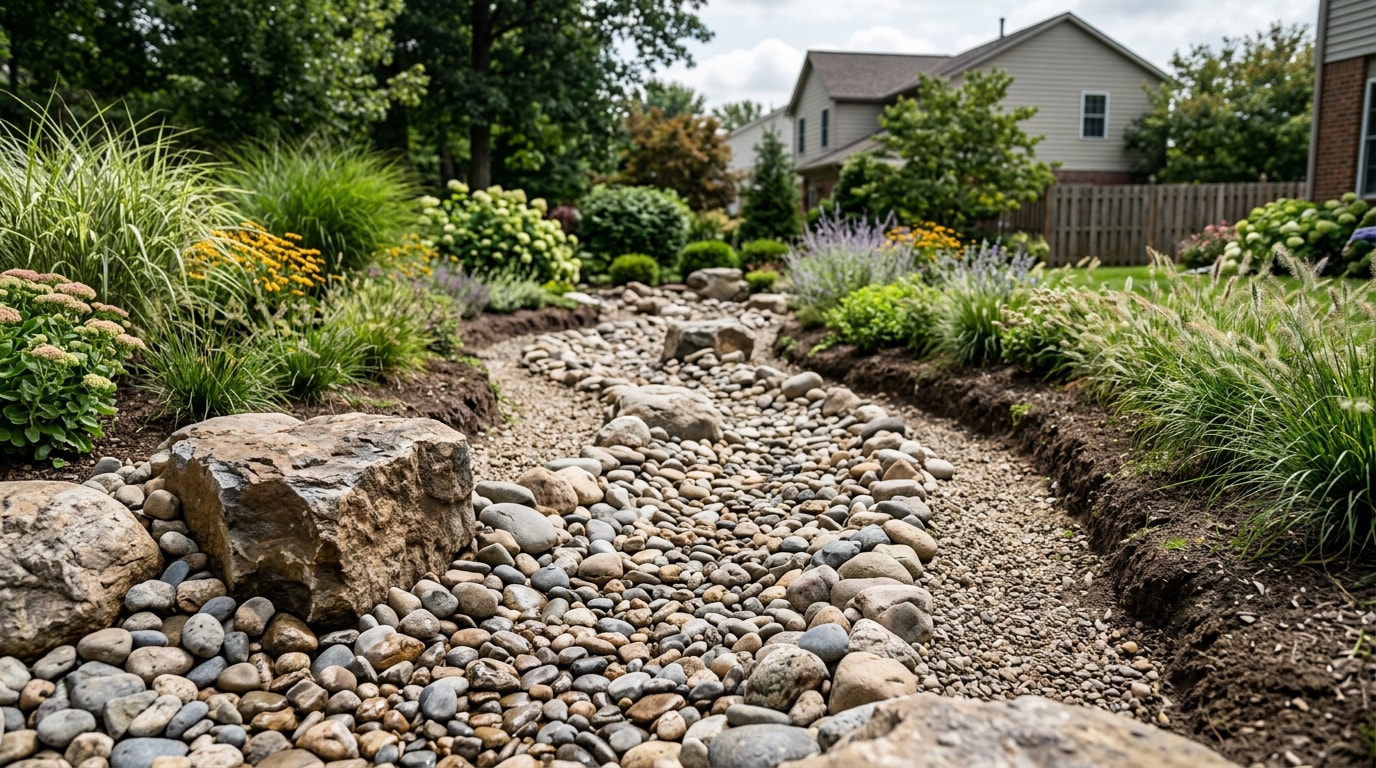
Dry creek bed landscaping in Madeira, OH turns a yard that holds water into one that moves it somewhere useful. Hamilton County's clay-heavy ground is the reason this rock-lined channel has become the default fix for standing water, washed-out mulch, and soggy turf in this part of Cincinnati. Here's how the design actually works, what it costs locally, and the one local rule that catches most DIYers off guard.
Signs Your Madeira Yard Needs a Dry Creek Bed
Most homeowners don't go looking for a drainage fix until the problem is visible and annoying.
Watch for these signs after a storm:
- Puddles that linger 24 to 48 hours after rain stops
- Spongy, soft patches of turf that squish underfoot
- Mulch washing out of beds near downspouts
- Algae or damp staining creeping along the foundation
- Downspout runoff dumping water right next to the house
- Driveway or patio runoff sheeting across the lawn
Not every item on that list needs the same fix. We've regraded enough Madeira lots to know a creek bed solves surface problems fast, but a soggy lawn with no visible flow pattern is usually a different animal entirely. If you're not sure which camp you're in, a hardscape installation assessment settles it quickly.
How a Dry Creek Bed Works
A dry creek bed gives surface water a defined path instead of letting it spread across the yard. It needs three things to function: a real water source, enough fall along its length, and a legitimate place for the water to go.
Stormwater runoff comes from rain or snowmelt that flows over land or impervious surfaces instead of soaking into the ground , which is exactly the problem a dry creek bed is built to manage. The source might be a downspout, a sloped driveway, an upslope neighbor's yard, or a low corner where water naturally collects. The outlet, whether a storm structure, rain garden, or low drainage area, is where the water finally leaves the system.
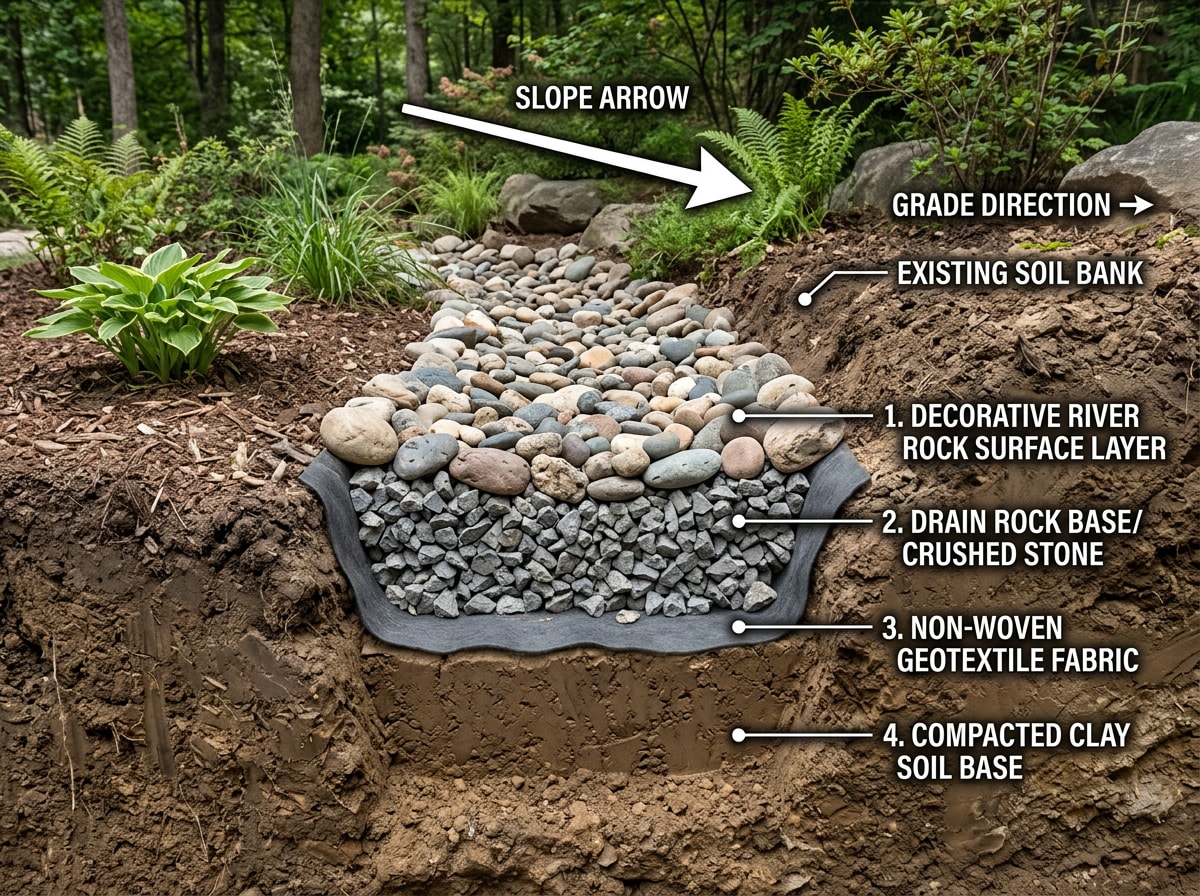
Slope matters more than most homeowners expect. Too little, and silt and leaves collect at the low points, causing the exact pooling you were trying to solve. Too much, and fast-moving water scours out the rock bed and undermines the banks. Most contractors aim for roughly a 1 to 2 percent grade along the channel as a starting rule of thumb, then adjust based on the actual water volume.
Local soil is part of why this matters so much here. Soil surveys for Hamilton County catalog several slow-draining map units, including Markland silty clay loam, 18 to 25 percent slopes, eroded , the kind of ground that turns a flat yard into standing water after an inch of rain. A channel graded too flat on this soil clogs with sediment within a season. One graded too steep washes smaller stones out of place after a hard rain.
A dry creek bed relocates water. It doesn't make it disappear. That's a planning problem as much as a construction one.
Dry Creek Bed vs. French Drain
A dry creek bed moves water across the surface of the yard. A French drain moves it underground through a buried, perforated pipe. The right choice depends on where your water problem is actually happening.
| Factor | Dry Creek Bed | French Drain |
|---|---|---|
| Handles | Visible surface runoff, sheet flow | Subsurface saturation, soggy soil |
| Visibility | Fully visible, doubles as a design feature | Buried, invisible once installed |
| Best for | Downspout discharge, driveway runoff, low spots | Foundation seepage, high water table |
| Typical install | Surface grading and rock | Trenching, pipe, and gravel at depth |
| Inspection | Easy to see problems and clean debris | Requires digging to inspect or repair |
If you can watch runoff travel visibly toward a low point after a storm, a dry creek bed is usually the better option. If the ground itself stays saturated or water seems to rise up through the soil rather than run across it, that's a subsurface problem, and a French drain is the right tool instead.
Madeira Stormwater Rules and Neighbor Liability You Should Know
Two things specific to Madeira and Ohio law matter before you dig, and neither shows up in generic drainage guides.
Madeira's zoning code caps impervious surface coverage on residential lots, and a compacted rock base or stone border can count toward that limit. The ordinance states that impervious surface coverage on a typical residence lot shall not exceed fifty percent (50%) of the total gross area of the underlying lot , with some flexibility if stormwater management techniques are part of the design.
Ohio also follows a "reasonable use" standard between neighbors on drainage disputes. If conditions on a landowner's property interfere with a neighbor's drainage, the landowner can be liable for the drainage interference even if she did not intend to interfere with the neighbor's drainage. In practice, a dry creek bed that dumps concentrated runoff onto a downhill neighbor's lawn can become a legal problem, not just a design one.
A properly planned outlet protects you as much as it protects your yard. If you're not sure whether your grading plan crosses that line, request a site assessment before you break ground.
Erosion Control and the Other Returns
Beyond stopping standing water, a well-built dry creek bed earns its keep in a few quieter ways:
- Erosion control — stone and planted banks slow concentrated flow so it doesn't carry soil away with it
- Groundwater recharge — planted banks slow stormwater long enough for some of it to soak in rather than rushing straight to a storm drain
- Pollinator habitat — drought-tolerant plants along the edges support bees and butterflies while cutting down the turf you need to water and mow
A dry creek bed functions like a small-scale version of the green infrastructure EPA recommends for managing runoff, which includes bioretention facilities, rain gardens, vegetated buffer strips, and grassed waterways on a larger scale. For plant pairings that actually hold up in Cincinnati's clay, see our planting guide for Mariemont yards, which covers many of the same drought-tolerant species.
Dry Creek Bed Ideas That Hold Up
The best designs do double duty: they look intentional and they actually move water.
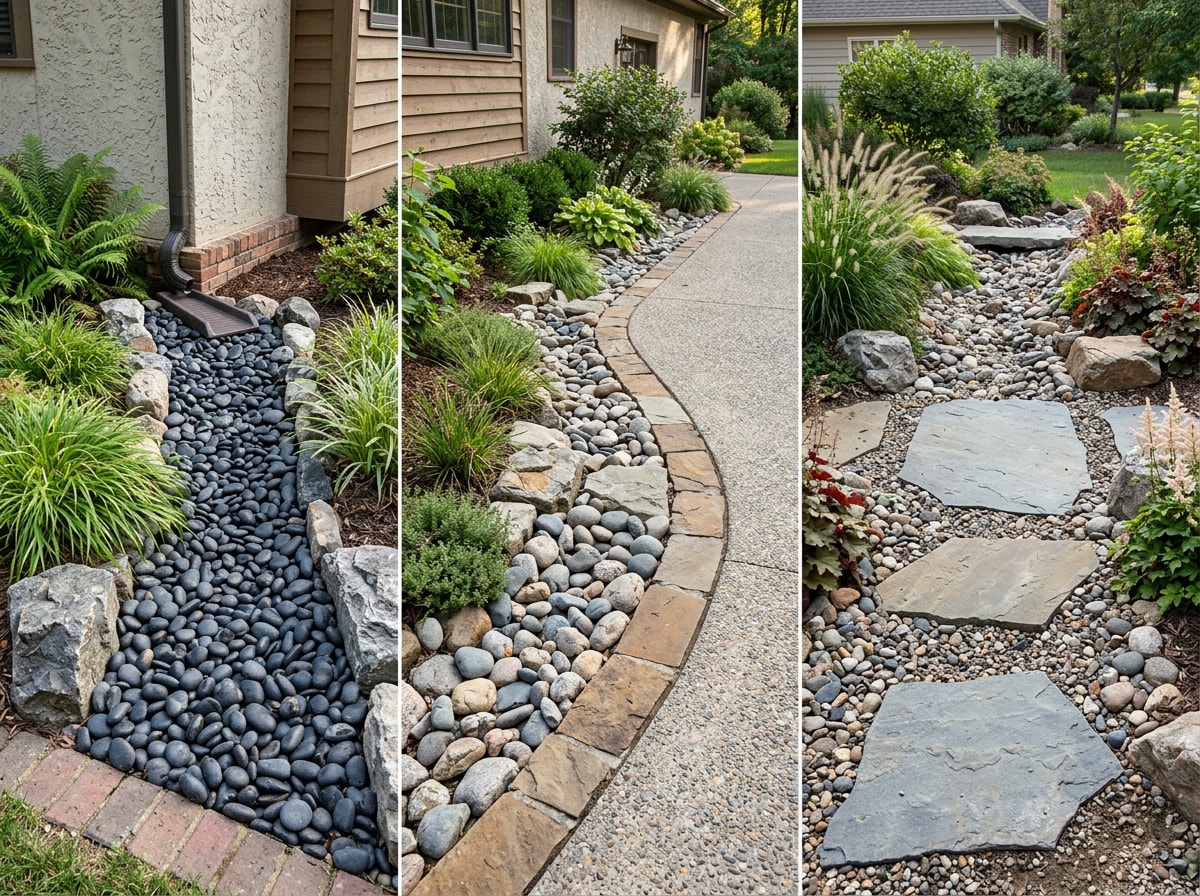
- River rock with anchor boulders — placed at turning points, this reads naturally and slows water at the same time
- Downspout mini creek — replaces a splash block outright, directing water several feet from the foundation instead of dropping it in one spot
- Driveway-edge interceptor — catches sheet runoff before it reaches the lawn or garage on clay-soil lots
- Stepping stone crossing — turns the bed into a walkable feature instead of an obstacle in narrow side yards
- Drought-tolerant plant banks — softens the rock edge and reduces long-term maintenance
Many older homes in Madeira's downtown core have modest gutter systems and shallow roof overhangs, which makes a rain-chain-fed mini creek bed an easy retrofit.
Design & Installation Process in Cincinnati
Good installations start with planning, not digging.
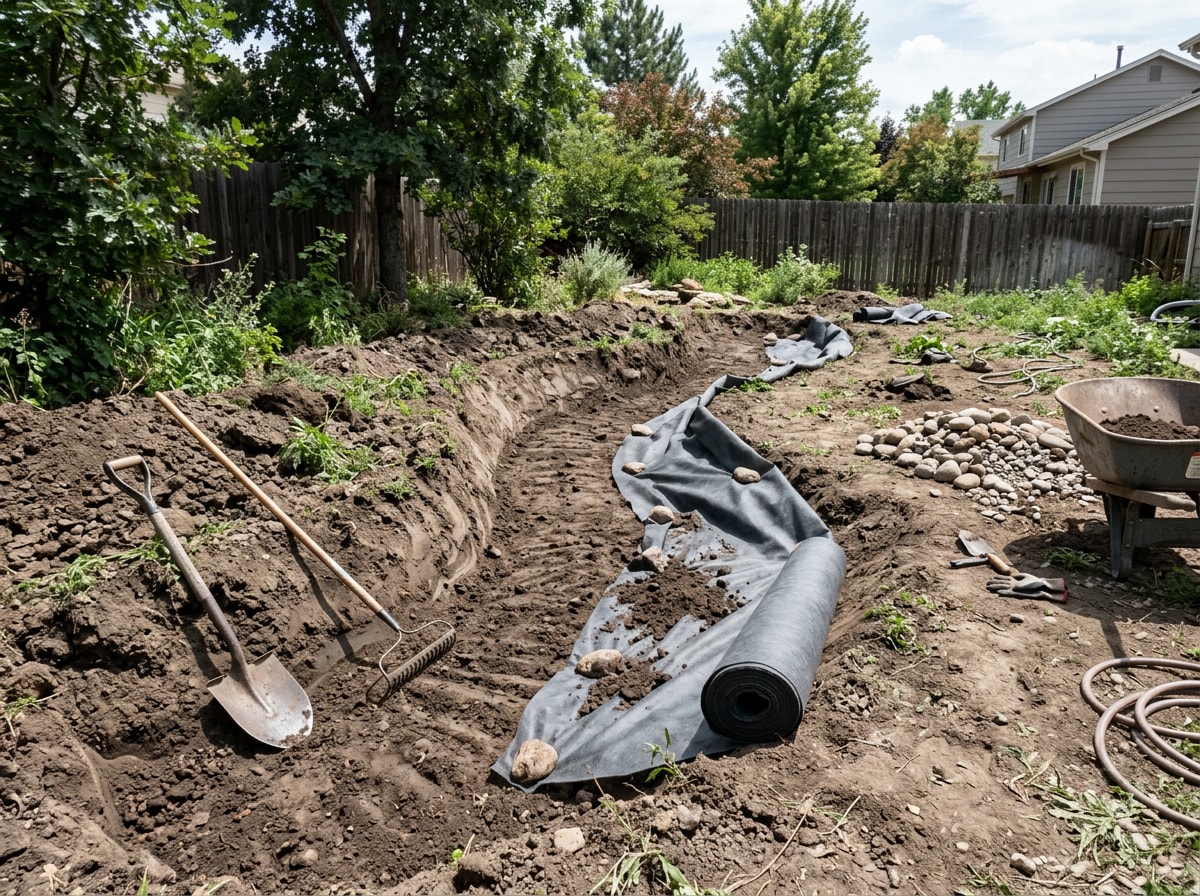
- Site walk and elevation mapping — confirms the water source, slope, and outlet line up before any excavation begins
- Layout and grading — the channel is shaped to the planned slope, typically 1 to 2 percent
- Fabric and base rock — a stable foundation layer prevents rocks from settling into the clay over time
- Boulder and stone placement — large anchor stones go in first, then mid-size cobbles, then the decorative surface layer
- Outlet tie-in and final grading — confirms water actually reaches the intended discharge point
Skipping the planning step is the most common reason a dry creek bed stops performing after the first heavy storm. See how we approach grading and hardscape work across the Cincinnati area before you commit to a design.
How Much Does a Dry Creek Bed Cost in Cincinnati?
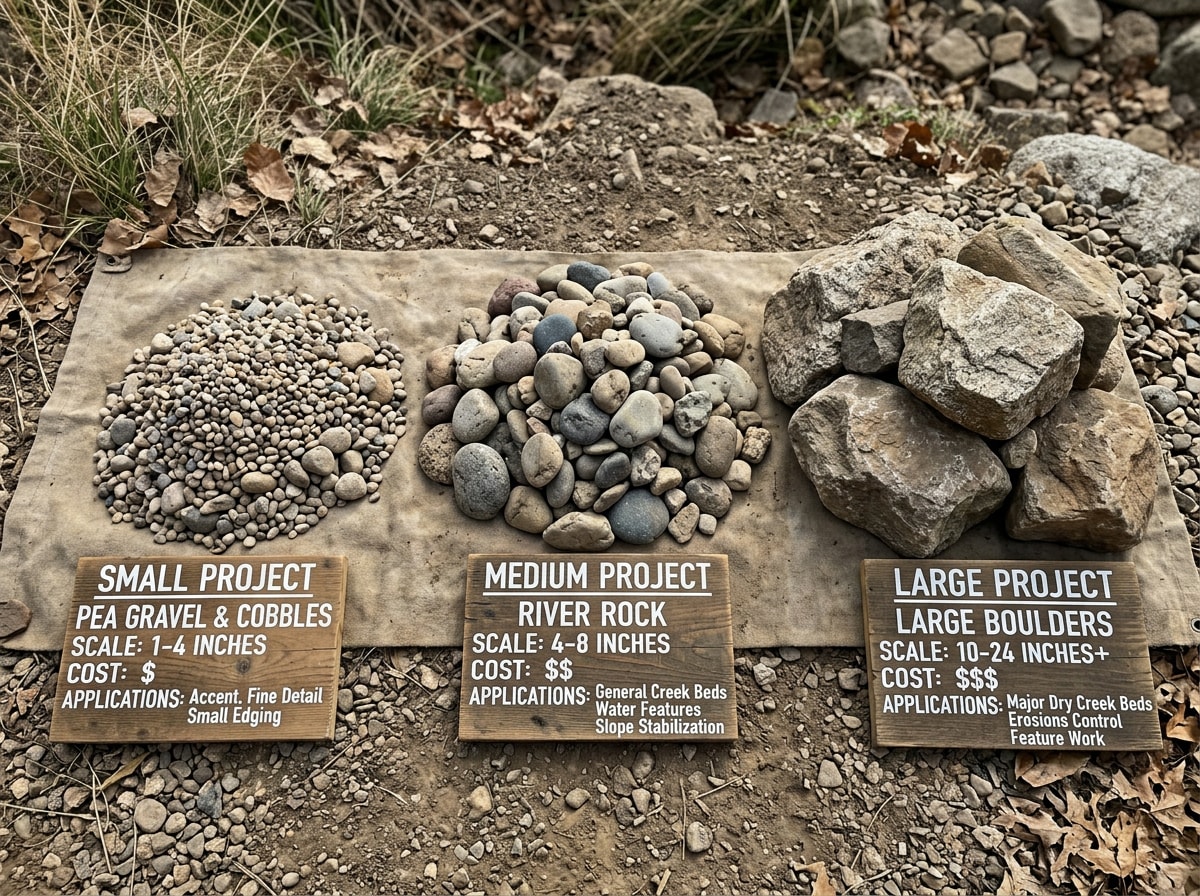
A standard, professionally installed dry creek bed in the Cincinnati area typically runs $30 to $60 per linear foot. Larger or more heavily featured designs with bigger boulders can reach $60 to $120 per foot. Most residential projects land somewhere between $2,000 and $8,000 total.
| Scenario | Typical Range |
|---|---|
| Small yard, easy access, standard rock | $2,000–$3,500 |
| Mid-size yard, moderate features | $3,500–$5,500 |
| Large yard, tight access, heavy clay excavation | $5,500–$8,000+ |
Cost factors include the channel's length and width, the mix of rock and boulder sizes, and how much excavation and spoil disposal the clay soil demands. Tight side yards that require hand-digging instead of equipment access also push costs higher.
Ready to see what your yard actually needs? Request a free estimate and we'll map the grading before you spend a dollar on rock.
About the Author
This guide was written by the design team at Nitescapes Cincy, a landscape and outdoor lighting design-build firm serving Madeira and the surrounding Hamilton County suburbs. Our crews have graded, piped, and rock-lined drainage systems on dozens of clay-soil lots across Cincinnati's eastern suburbs, and we've seen firsthand how often a flat-graded channel clogs within a season. You can see our full service area and current project work from the Nitescapes Cincy homepage.
FAQ
What is a dry creek bed called?
A dry creek bed is also called a dry stream bed or dry river bed. In the American Southwest, the same feature is often called an arroyo. A swale is related but broader, usually grassed rather than rock-lined, and sometimes shallower.
Will a dry creek bed help with a wet, soggy lawn?
Not always. A soggy lawn usually means water sitting in the soil, not moving across the surface, so a channel can't fix water that's already underground. That situation typically needs subsurface drainage, soil improvement, or regrading instead.
How much slope does a dry creek bed need?
Most contractors aim for roughly a 1 to 2 percent slope along the channel's length to keep water moving toward the outlet without pooling or scouring. Flatter yards risk silt buildup at low points, while steeper grades can wash smaller stones out of place.
What rocks are best for a dry creek bed?
A layered mix works best: a base layer of drain rock for stability, mid-size cobbles along the banks, river rock for the visible channel bed, and a few large anchor boulders at turns and the outlet. Using only one rock size tends to look like a driveway rather than a natural streambed.
Do I need a permit for a dry creek bed in Madeira, OH?
It depends on the size and whether it changes your lot's impervious surface coverage. Madeira's zoning code limits impervious coverage on residential lots, so a large stone-bordered or compacted-base design may need to factor into that calculation. Check with the city or ask your contractor to confirm before installation.
Will a dry creek bed help with drainage?
Yes, for surface runoff and erosion control, a dry creek bed is genuinely effective. It isn't a fix for groundwater problems or foundation seepage, which call for a different drainage solution entirely.