
When you're comparing outdoor lighting repair companies in Liberty Township, OH, most homeowners are dealing with the same handful of root causes: a bad splice, a worn photocell, or a transformer that's finally given out. Knowing what those causes look like helps you describe the problem accurately and avoid paying for guesswork. This guide covers warning signs, real repair costs, safe DIY checks, and the questions worth asking before you hire anyone.
Signs Your Outdoor Lighting Needs Repair
Most landscape lighting failures show warning signs before everything goes dark. Recognizing the pattern makes it easier to describe the issue clearly, which usually means a faster, more accurate diagnosis.
The Entire System Goes Dark
A landscape lighting system that's completely dark usually points to the power source rather than individual fixtures. Outdoor lighting failing across the whole yard typically signals a failed transformer, a tripped breaker, or a break in the main feed cable, not several bulbs burning out at once.
Lights Flicker or Work Only Sometimes
Flickering landscape lights, or fixtures that only work sometimes, often trace back to a loose connection, a failing bulb, or a timer or photocell problem. Intermittent outdoor lighting can also worsen with temperature swings, since connections expand and contract throughout the day.
Common Outdoor Lighting Problems and How They're Fixed
Once a symptom is identified, a technician is usually narrowing the cause down to something underground or something in the controls.
Cut, Nicked, or Rodent-Damaged Wiring
Low-voltage cable is often buried just a few inches deep, leaving it exposed to aerating equipment, edging tools, digging animals, and rodents. A visible break shows bare copper and is quick to spot. A hidden splice failure is trickier. It sits underground with no obvious sign beyond dead fixtures downstream, and because runs are wired in series, one damaged section can knock out an entire zone.
National Electrical Code guidance sets minimum cover depth for low-voltage landscape circuits, but Southwest Ohio's freeze-thaw winters push frost into shallow soil every year. In our experience working on Liberty Township properties, splices buried right at the code minimum are more likely to loosen or crack over a few winters than splices buried a little deeper with sealed, direct-burial-rated connectors. That's one reason a repair visit often costs a bit more than a quick patch: doing it right means re-sealing the connection for the ground it's actually sitting in, not just the code minimum. For more on how these systems are wired correctly the first time, see our guide on landscaping lights wired for safety and longevity.
Photocells and Timers Wear Out Too
A failed photocell can leave lights off at night or on all day, since it's the sensor reading ambient light levels. A timer problem causes similar symptoms, including wrong on/off times and random shutoffs, and it's worth ruling out before assuming the issue is electrical. Dusk-to-dawn sensors generally last several years but do fail with age and weather exposure.
How Much Does Outdoor Lighting Repair Cost?
Pricing varies by what actually failed, but industry-wide cost data consistently lands in a similar range. Most outdoor lighting repairs run between $20 and $600, with a typical job landing around $250. A single bulb or fixture swap sits at the low end, often under $100. Wiring repairs, including locating and splicing damaged underground cable, usually run $150 to $350 depending on how many fixtures are affected downstream.
| Repair Type | Typical Cost Range | Notes |
|---|---|---|
| Bulb or fixture socket | $20–$75 | Fastest, most routine fix |
| Timer or photocell | $60–$200 | Rule out before assuming wiring |
| Wiring or splice repair | $150–$350 | Price rises with number of fixtures affected |
| Transformer repair or swap | $200–$600 | Higher end if it becomes a full upgrade |
An exact price generally requires an on-site look, since buried wiring issues are hard to estimate sight unseen. Once you've noted which symptoms match your system, you can request a free estimate rather than guess at the scope.
How to Check Your Outdoor Lighting System Before Calling a Pro
A few checks are safe to run yourself before scheduling service:
- Confirm the timer and photocell settings are correct for the season.
- Check whether the breaker or outlet feeding the transformer has tripped.
- Look for obvious cut cable near recent digging or landscaping work.
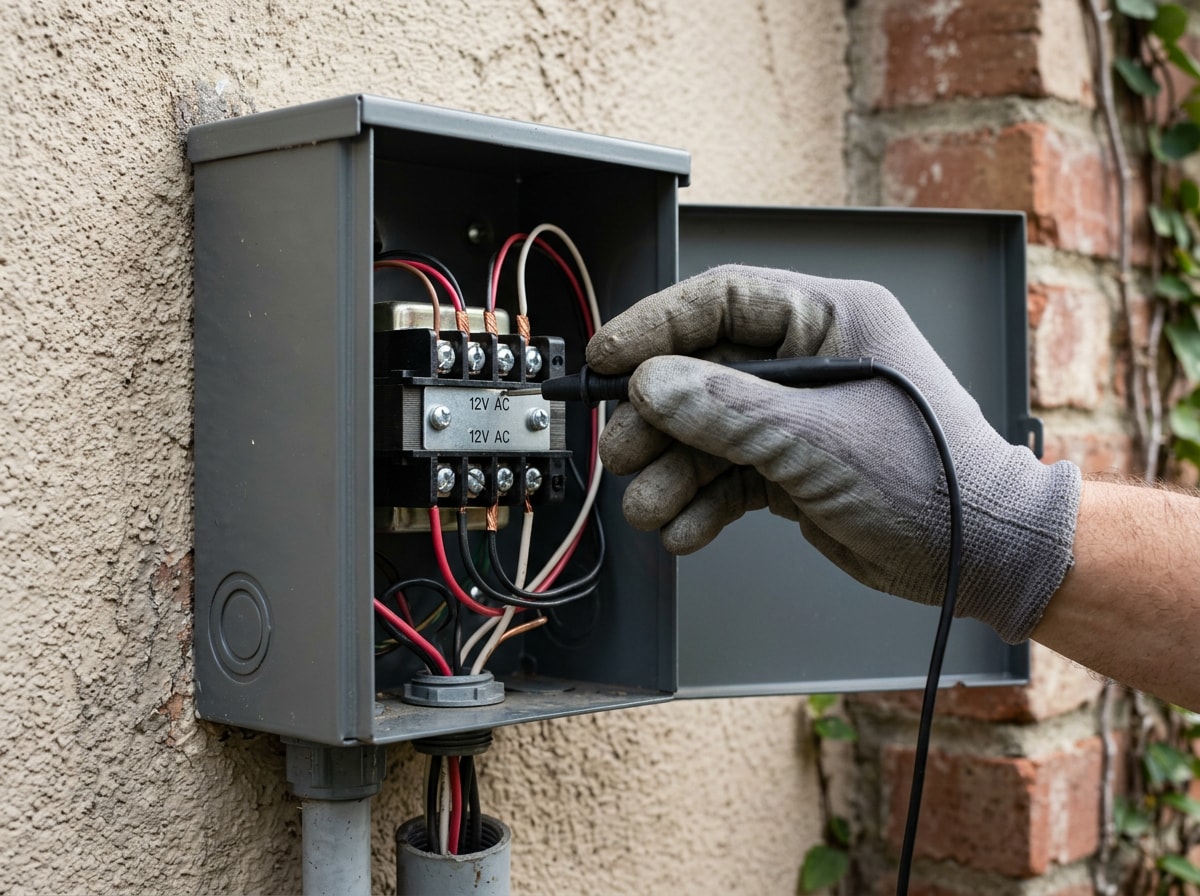
- If comfortable, check the transformer's output with a multimeter.
Anything beyond that, including opening the transformer housing or tracing buried wire, is where a professional diagnostic visit earns its cost. A lighting consultant can test the full system methodically instead of swapping parts and hoping.
What a Thorough Outdoor Lighting Repair Visit Includes
Certain signals mean it's time to stop troubleshooting on your own: an entire zone going dark at once, fixtures that keep failing after being replaced, visible corrosion at connectors, or a system that's noticeably dimmer overall. These point to issues beyond a quick fix.
A proper visit starts with voltage testing at multiple points along the run, not guessing. It includes inspecting splices for corrosion and asking what the system looked like when it last worked correctly, which helps narrow down when the problem began.
A complete job also covers:
- Replacing faulty transformers, not just resetting them.
- Swapping broken or corroded fixtures.
- Retesting the entire system, not just the fixture originally reported as broken.
- Documenting the fix so the homeowner knows what was done and why.
Fixture replacement and full-system testing should be standard parts of the visit, not add-on charges. You can see examples of completed outdoor lighting work on our project gallery.
Repair vs. Replace: Should You Fix or Upgrade Your System?
Not every repair is worth making. An undersized transformer that's been quietly overloaded for years, often because fixtures were added without rechecking capacity, won't really be fixed by repairing one failed connection. This is a common discovery during a professional inspection, and it's usually a sign that a transformer upgrade makes more sense than repeated repairs.
Repair-or-replace decisions often line up well with an LED conversion, since LED fixtures draw far less power than halogen bulbs, which can extend transformer life and cut energy use. The U.S. Department of Energy's lighting guidance notes that outdoor LED fixtures can save significant energy over older bulbs when left on for long stretches, which is exactly how most landscape lighting runs. If a repair opens the system up anyway, it's worth weighing against an outdoor LED lighting upgrade instead of replacing like-for-like.
What to Know Before Hiring an Outdoor Lighting Repair Company
A little preparation before you call makes the conversation, and the quote, more accurate.
Assess Your Outdoor Lighting Issues and Project Scope
Walk your outdoor space at dusk and note exactly where lighting is poor, flickering, or completely dark. This kind of walkthrough gives a repair company a much clearer sense of scope than a vague description, and it often speeds up the estimate process.
Verify Credentials and Insurance
Ask whether the technician is a licensed and insured electrician for the work being performed, and don't hesitate to ask for proof. A Certified Low Voltage Lighting Technician credential from the Association of Outdoor Lighting Professionals signals training specific to 12-volt landscape systems, beyond general electrical work. Refusing to produce proof of insurance is a red flag worth walking away from.
Questions to Ask an Outdoor Lighting Repair Company
Good questions fall into four categories, and each protects you differently:
- Credential questions confirm the company can legally and safely do the work.
- Experience questions gauge whether they've handled your specific problem before.
- Process questions reveal whether they test thoroughly or just swap parts.
- Warranty and pricing questions protect you after the technician leaves.
Bring at least one question from each category to your estimate call, and ask for everything in writing before work starts.
Preventative Maintenance for Outdoor Lighting
Preventative care matters more for low-voltage outdoor lighting than for most home systems, since its wiring sits buried and exposed to moisture, roots, and digging animals year-round. A seasonal checkup should include testing transformer voltage, inspecting visible connections for corrosion, and confirming timer and photocell settings as daylight hours shift with the seasons.
Most quality transformers last well over a decade if they aren't overloaded or exposed to standing water, but routine maintenance catches small problems, like a loosening connector or a dimming zone, before they turn into a full repair call. Homeowners throughout Liberty Township and the wider Cincinnati area can learn more about our approach on the NiteScapesCincy homepage.

FAQ
Why do my landscape lights seem dimmer than they used to be?
Dim landscape lights usually result from voltage drop along the wire run or an aging transformer that no longer puts out full power. Both tend to worsen gradually rather than fail all at once.
How deep are landscape lighting wires buried?
Low-voltage lighting wires are typically buried at least 6 inches deep, though exact depth depends on local code and soil conditions. Many installers bury splices a bit deeper than the minimum in areas with hard winter freeze-thaw cycles.
Is system testing part of the repair process for outdoor lighting?
Yes. A complete repair visit includes post-repair testing of the entire outdoor lighting system, not just the single fixture originally reported as broken.
Can a professional repair a system installed by another company?
Yes. A reputable repair company can diagnose and fix an existing system it didn't originally install, including tracing unfamiliar wiring layouts.
Is it worth repairing an old landscape lighting system, or should I replace it?
It depends on the age and condition of the transformer and wiring. If repairs keep recurring on the same circuit, or the transformer is already undersized for the fixture load, replacement or an LED upgrade usually costs less over time than repeated service calls.
How long do landscape lighting transformers last?
Most well-maintained transformers last more than a decade. Overloading, moisture intrusion, and sun exposure are the biggest factors that shorten that lifespan.
Can I troubleshoot landscape lighting myself?
You can safely check timer and photocell settings, look for obvious cut cable, and confirm the breaker hasn't tripped. Opening a transformer housing or tracing buried wire is where it's worth calling a professional.